Shop is live

We build Workstation AI machines for websites, AI agents, and LLM training — configure and buy online.

Get Trade Prices
AI Products
AI LabsOpenAI AgentsClaude AgentsGrok BotWorkstation AI native CRMMarketingAll Products
AI Solutions
Applied AIAI AgentsGenerative AIAI AutomationAI UpskillingAI SME PackagesEnterprise AI LabAI WorkstationsNVIDIA Hardware & SoftwareNVIDIA Accelerated ComputingPrivate AIGPU Private CloudGPU ClustersEdge AIAI by Industry
AI Services
Platform ModernisationDigital EngineeringData Foundations & AIAutonomous OperationsAI ConsultancyDevOps AutomationCyber SecuritySoftware DevelopmentAgent BuildingMLOps SetupGPU LeasingGPU Private Cloud
About Us
CompanyOur StoryPartnersCustomer Stories
AI Data Centres
AI Data CentresGPU Private CloudGPU ClustersGPU Leasing
AI InsightsJev seriesBenchmark LabModel selection
Technical Notes
Documentation
Linux OSUbuntuRed Hat Enterprise LinuxSUSE LinuxAlpine LinuxDebian, Rocky & AlmaLinux
AI Cloud PlatformsAWS & Amazon BedrockGoogle Cloud & Vertex AIMicrosoft Azure & AI FoundryGPU clouds & marketplaces
Private AI Data CentresFor law firmsFor accounting firmsOn-premises platformsFully secured cloud
ToolsRing PromoterJobshout
News
Blog
Contact UsSign in

AI workstations, AI Multi Agentic Software, GPU infrastructure, and intelligent agent solutions for modern businesses.

Contact Us

AI Solutions

Applied AIAI AgentsGenerative AIAI AutomationAI UpskillingAI SME PackagesEnterprise AI LabAI by Industry

Products

All ProductsWorkstation AI native CRM & ERPMarketingOpenAI AgentsRing PromoterJobshout

Company

About UsCompanyAI Data CentresWhy WorkstationPartnersCustomer StoriesPricingContactTenthMatrix

Resources

AI InsightsTechnical NotesDocumentationLinux OSAI Cloud PlatformsPrivate AI Data CentresBlogSearchSitemap
UK Head Office
77-79 Marlowes, Hemel Hempstead HP1 1LFDirections - Take Junction 20 off M25 Outer LondonCompany No: 11641870Mon - Fri: 9:00 AM - 6:00 PM GMT
+44 7515 356 146
Belgium Office
Workstation SRL, Rue Vanderkindere 34, 1180 Uccle, BrusselsBE 0751.518.683Mon - Fri: 9:00 AM - 6:00 PM CET
+32 492 45 67 46
India Office
#159 Sector 9, Pocket 1, DDA Flats, 110077 Dwarka, New Delhi
+91 98881 98841
Taiwan Office
3F, No. 2-4, Aisi Rd., Ren'ai Dist., Keelung City 200, Taiwan基隆市仁愛區愛四路2之4號3樓Mon - Fri: 9:00 AM - 6:00 PM Taiwan time (GMT+8)
+886 926 892 701+32 492 45 67 46

© 2026 Workstation AI. All rights reserved.

PrivacyData DeletionCookiesTerms of ServiceWebsite Sitemap

NVIDIA, the NVIDIA logo, RTX, RTX PRO, Blackwell, CUDA, NVLink, MGX, Omniverse, Spectrum-X, Quantum, BlueField, DGX and HGX are trademarks and/or registered trademarks of NVIDIA Corporation in the US and other countries. AMD, the AMD Arrow logo, EPYC, Instinct, Ryzen and Threadripper are trademarks of Advanced Micro Devices, Inc. Dell and PowerEdge are trademarks of Dell Inc. or its subsidiaries. Intel and Xeon are trademarks of Intel Corporation or its subsidiaries. AMAX, AceleMax and LiquidMax are trademarks of AMAX Engineering Corporation. All other product names, logos and brands are the property of their respective owners. We use them only to identify the products we describe, supply or support; their use does not mean their owners endorse us.

Loading blog...

Home / Blogs
DevOpsSREKubernetesObservabilityPrometheusOpentelemetryFinOps

Observability Is Not Optional: Make It a Business Standard

For managers and owners: centralise telemetry, standardise platforms, and treat monitoring as a release requirement — not a team preference

Balinder WaliaOctober 8, 20263 min read
Observability as a business standard

For managers and business owners: observability is not a tool preference — it is how the company knows whether products, payments, and AI agents are healthy. Make it a centralised standard, not an optional side project. Technical companion: Big Prometheus, pros/cons, and MoSCoW of the tool landscape. Related: LLM bottlenecks & cost control.

Observability as a business standard

Board sentence. If every team picks its own monitoring, you do not have observability — you have folklore, duplicate invoices, and slow incidents. Centralise the contract (what every service must emit), standardise the platforms, and treat “no dashboards / no alerts” as a release blocker — the same way you treat no backups.

Why this is a business decision, not an SRE hobby

When a checkout fails at 2am, leadership does not ask which open-source database won a benchmark. They ask: how long until we know, how long until we fix, and how do we stop this recurring? Those answers only exist if metrics, logs, traces, and alerts live in a shared system with clear ownership.

Optional observability creates predictable failure modes:

  • Blind spots — a critical service “didn’t have time” to add metrics.
  • Tool sprawl — three APMs, two log products, no single truth for SLOs.
  • Cost surprises — high-cardinality labels and unsampled traces blow budgets.
  • Audit gaps — regulators and enterprise customers ask for evidence; screenshots from Slack do not count.
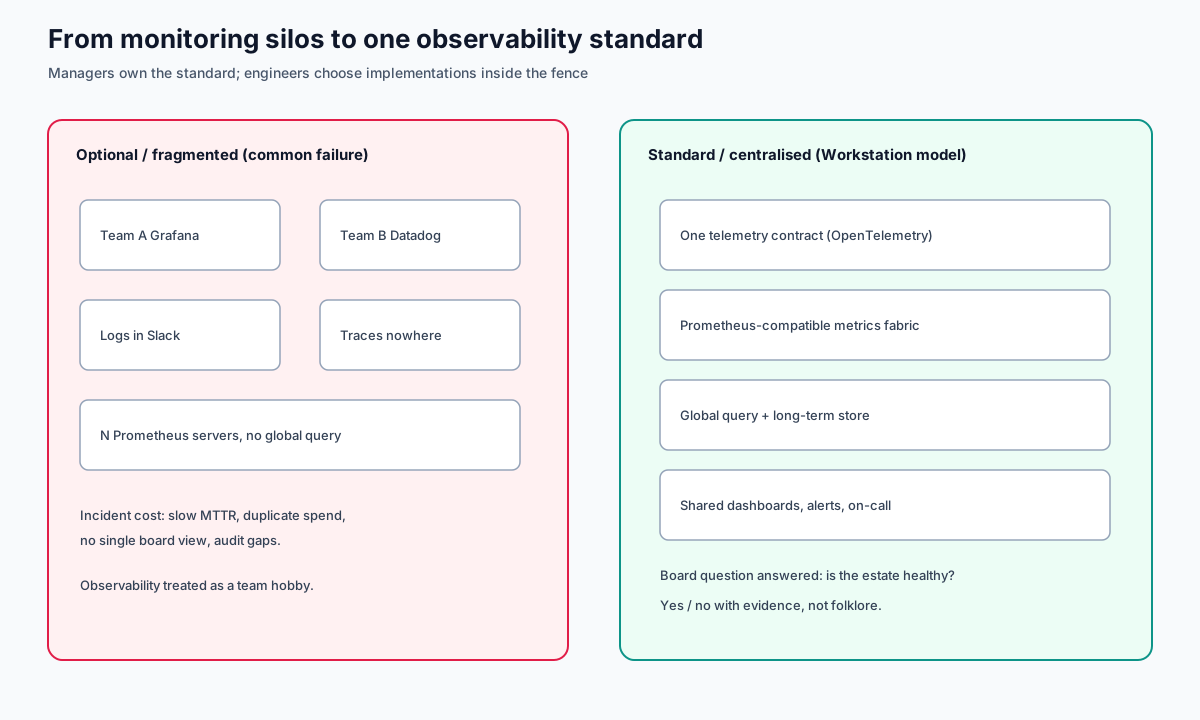
Siloed monitoring versus centralised observability standard

What “centralised and standard” means in practice

Centralised does not mean one vendor forever. It means:

  1. One telemetry contract — every production service emits metrics, logs, and traces in approved formats (typically OpenTelemetry + Prometheus).
  2. One place to ask estate questions — “which clusters are on fire?” and “what was error rate seven weeks ago?” without hopping ten UIs.
  3. One on-call and alert taxonomy — severity, ownership, and escalation are shared language.
  4. One FinOps leash — retention, sampling, and cardinality budgets are policy, not heroics.

Inspired by the open-source “Big Prometheus” conversation (Thanos, Cortex/Mimir, M3, VictoriaMetrics), the engineering choice is how you scale that standard across many Kubernetes clusters — not whether you need a standard at all.

MoSCoW in one slide for leadership
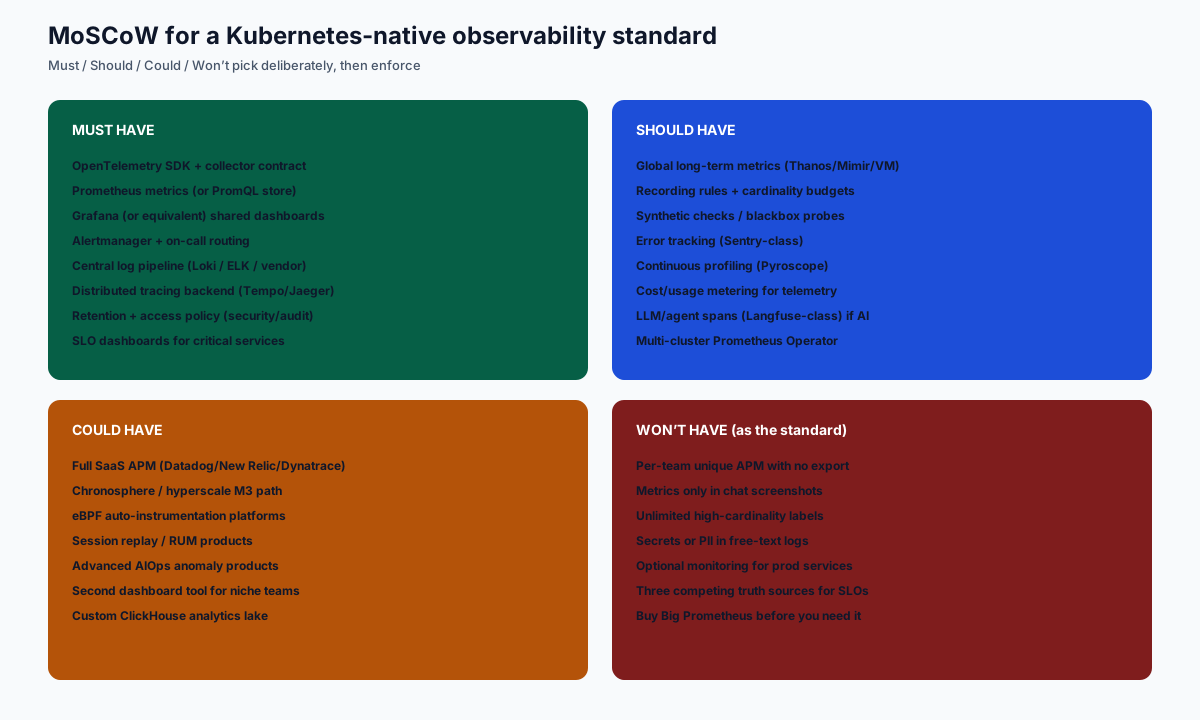
MoSCoW map of observability capabilities

  • Must — OpenTelemetry contract, PromQL metrics, shared dashboards, alerting/on-call, central logs, tracing, retention/access policy, SLOs for critical journeys.
  • Should — global long-term metrics store, cardinality budgets, synthetics, error tracking, profiling, telemetry cost metering.
  • Could — full SaaS APM, hyperscale commercial stacks, eBPF auto-instrumentation, RUM/session replay.
  • Won’t (as the standard) — per-team unique APMs with no export, metrics-as-screenshots, unlimited cardinality, optional monitoring for production, three competing SLO sources.

What managers should fund and enforce

  • Platform ownership — a small team owns the standard; product teams consume it.
  • Definition of Done — no production release without golden signals and runbooks linked to alerts.
  • Budget as policy — pay for retention and query performance deliberately; do not “save money” by going blind.
  • Quarterly reviews — tool sprawl, MTTA/MTTR trends, and top cardinality offenders.

Workstation’s stance

Workstation runs GPU storefronts, AI agents, edge proxies, and promotion rings. Those surfaces only stay trustworthy if observability is mandatory across INT → TEST → ACC → PROD — the same discipline we apply to secrets and releases. For the engineering deep dive — Big Prometheus options, honest pros/cons, and a full MoSCoW of the tool landscape — read the technical article.

Want a single observability standard across your clusters and AI workloads? Talk to Workstation.